Paladin 5eClass Guide & NPC Generator
Sacred oaths, the full spell list and slots, features by level and ability priorities — then forge a finished paladin NPC, portrait and all, without typing a thing twice.
A paladin is a holy warrior bound by a Sacred Oath — heavy armour and a shield at the front, divine power channelled into smites, healing and an aura that steadies everyone standing near them. Charisma powers almost all of it.
Choose your subclass
Paladin Subclasses — The Sacred Oaths
An oath is not a spell — it is a promise, and the power answers the promise. Choose one; the forge follows.
Lawful Good
Oath of Devotion
Honesty, courage, compassion. The classic holy knight — and the hardest promise to keep, because it never bends.
Full Oath of Devotion guide →The Forge
Forge Oath of Devotion Paladin
Everything you have chosen travels with you and arrives pre-filled. Nothing to type twice — just press Generate.
Oath of Devotion · level 5 · pre-filled for you
Role in party
The Holy Warrior
Paladin = the party’s armored anchor — tanking, burst healing, and nova damage through Divine Smite.
You want to be the party’s iron wall and its burst damage at the same time.
Related Questions
Can a Paladin get their powers from a non-divine source in D&D?
Yes. A paladin’s power comes from the Sacred Oath they swear, not from a deity, so it can flow from a personal code, an ancestral vow, or a cause rather than any god.
Read the full answer →Can a Paladin take an oath without having a deity or patron in D&D 5e?
Absolutely — the oath is a promise, and its power answers the promise rather than a patron. A paladin can serve an ideal, an ancestor, or a cause and never worship a god at all.
Read the full answer →What does the Paladin aura of protection do at level 7 in D&D 5e?
The Aura of Protection comes online at 6th level and is fully active at 7th: while you’re conscious, you and allies within 10 feet add your Charisma modifier to every saving throw. It doesn’t change at 7 specifically — it simply keeps protecting the party until it widens to 30 feet at 18th.
Read the full answer →Show 2 more questions
Is a Paladin who breaks laws to fight evil Lawful or Neutral?
5e paladins are bound by their oath’s tenets, not by a fixed alignment, so bending a law to stop a greater evil doesn’t automatically shift you off Lawful. Alignment describes how you act; it isn’t a rule the class enforces.
Read the full answer →Why do optimizers consider Paladin boring to play in D&D 5e?
The core loop is simple — attack, then spend a slot to Divine Smite when a hit matters. That same straightforwardness is why the class is forgiving to learn and hits far above its weight.
Read the full answer →Forged this morning
The Oathsworn

Oath of Devotion · Level 5 · Lawful Good
Ser Aldric Vane
A templar of the Silver Dawn who has never once broken his word — and it is starting to cost him. He carries the names of everyone he could not save, written inside the shield.
Related Questions
Which Paladin spec is best?
There’s no single best oath — it depends on your concept and party. Only the Oath of Devotion is in the free SRD; damage-focused tables often favour Vengeance or Conquest, while Ancients and Redemption lean protective.
Read the full answer →What is the strongest Paladin subclass in 5e?
It depends what you measure: Vengeance and Conquest are prized for offense and control, while Devotion’s accuracy boost pairs beautifully with big smites. Note that only Devotion is SRD; the rest come from paid expansions.
Read the full answer →What oath is best for a wholesome support Paladin in 5e?
For a warm, party-supporting paladin the protective oaths shine — the Oath of the Ancients and Oath of Redemption both favour endurance, allies, and de-escalation over raw damage. The SRD’s Oath of Devotion also plays a fine, upstanding role.
Read the full answer →Show 2 more questions
What is the best Paladin subclass for a revenge-focused character in D&D 5e?
The Oath of Vengeance is the traditional pick for a revenge-driven character, built around relentlessly hunting a marked foe. It’s an expansion oath rather than part of the SRD, so confirm its features in their official source.
Read the full answer →What is the difference between Oath of Vengeance and a self-serving Paladin in D&D 5e?
An Oath of Vengeance paladin pursues wrongdoers in the name of justice for others, even at personal cost, whereas a purely self-serving character chases their own ends. The oath still expects the promise, not personal gain, to guide the vengeance.
Read the full answer →Chosen lineage
Best Races for a Paladin
Charisma drives everything, so the best lineages either pump it or cover the paladin’s blind spots.
Half-ElfGUIDE →
Charisma plus two floating points and a fistful of skills — the all-rounder’s first pick.
DragonbornGUIDE →
Breath weapon covers the paladin’s missing AOE, and the draconic theme fits the armour.
AasimarGUIDE →
Radiant Soul / Consumption stacks straight onto Divine Smite damage.
Variant HumanGUIDE →
A feat at level 1 (Polearm Master or Sentinel) — the build comes online immediately.
Hill DwarfGUIDE →
Extra HP and stronger saves — the tankiest, most immovable paladin chassis.
Where the points go
Paladin Builds — Where the Points Go
Charisma is the engine: it drives your smites, your aura and your spell save DC. Everything else serves it.
Sword-and-board smiter
The default. Strength swings the blade; Charisma drives smites, auras and your spell save DC.
Finesse / mobile
Rapier and shield, lighter armour — the same Charisma engine on a faster chassis.
Support / face
Lean on Aura of Protection, Lay on Hands and the social pillars. You are the party’s spine.
Top picks
Best Feats for a Paladin
Smite damage scales with attacks and opportunity attacks — so the best feats buy you more of both.
Combat doctrine
Fighting Styles
Chosen at level 2, before your oath — it quietly shapes the whole build.
Defense
Sword-and-board tank.
Dueling
Sword-and-board damage.
Great Weapon Fighting
Two-handed Smite burst.
Protection
Pure protector.
Blessed Warrior
Support / roleplay-leaning.
Multiclass combos
Best Paladin Multiclass Combos
Half-casting and Divine Smite make the paladin one of 5e’s best multiclass bases.
SorcadinGUIDE →
Metamagic and a full pool of slots, all feeding Divine Smite — the highest-DPR paladin build.
PadlockGUIDE →
Short-rest slots refill your Smites, and Eldritch Blast covers your ranged blind spot.
Paladin / BardGUIDE →
Every skill, Bardic Inspiration and more slots — the most versatile build of the three.
Armory
Best Paladin Equipment by Tier
What to carry as you level — from a starting longsword to a Holy Avenger.
The Litany
Spell List
Paladins prepare from the full list each day. Spellcasting arrives at level 2 — save the slots for Divine Smite.
Half-caster
Spell Slots by Level
| Paladin level | 1st | 2nd | 3rd | 4th | 5th |
|---|---|---|---|---|---|
| Level 1 | — | — | — | — | — |
| Level 2 | 2 | — | — | — | — |
| Level 3 | 3 | — | — | — | — |
| Level 4 | 3 | — | — | — | — |
| Level 5 | 4 | 2 | — | — | — |
| Level 6 | 4 | 2 | — | — | — |
| Level 7 | 4 | 3 | — | — | — |
| Level 8 | 4 | 3 | — | — | — |
| Level 9 | 4 | 3 | 2 | — | — |
| Level 10 | 4 | 3 | 2 | — | — |
| Level 11 | 4 | 3 | 3 | — | — |
| Level 12 | 4 | 3 | 3 | — | — |
| Level 13 | 4 | 3 | 3 | 1 | — |
| Level 14 | 4 | 3 | 3 | 1 | — |
| Level 15 | 4 | 3 | 3 | 2 | — |
| Level 16 | 4 | 3 | 3 | 2 | — |
| Level 17 | 4 | 3 | 3 | 3 | 1 |
| Level 18 | 4 | 3 | 3 | 3 | 1 |
| Level 19 | 4 | 3 | 3 | 3 | 2 |
| Level 20 | 4 | 3 | 3 | 3 | 2 |
The Long Road
Features by Level
Related Questions
Is dual wielding worth it for a Paladin in 5e?
Usually not. A shield plus the Dueling fighting style tends to give better armour class and damage than two-weapon fighting, and dual wielding competes for the bonus action you’ll often want for Lay on Hands or a spell.
Read the full answer →What feat should a new Paladin take at level 4 when the party already has a Druid, Rogue, and Eldritch Knight?
With no dedicated front-liner in that party, a tanking feat like Sentinel or Polearm Master lets you hold the line and control the space around you. If you’re the main damage dealer instead, Great Weapon Master raises your ceiling.
Read the full answer →What are the best Aasimar racial features for a Paladin?
Aasimar raises Charisma — the paladin’s core stat — and its later celestial transformations add radiant damage that lands right alongside your smites, making it one of the most synergistic paladin lineages.
Read the full answer →Show 2 more questions
Why do most Sorcadin builds recommend stopping at Paladin 6 for Aura of Protection?
Paladin’s best per-level returns are Extra Attack at 5th and the Aura of Protection at 6th, so many Sorcadin builds bank those six levels before pivoting into sorcerer for extra slots to smite with.
Read the full answer →What is the best Paladin level to stop multiclassing in D&D 5e?
Most paladin multiclass plans secure at least the first six levels — through Extra Attack and the Aura of Protection — before splitting off, since those are the class’s strongest features per level.
Read the full answer →Related Questions
What is the one spell slot per turn rule for Paladins in D&D 5e?
There’s no official “one slot per turn” rule; the real limit is one Divine Smite per weapon hit — you can’t pile multiple slots onto a single swing. Land a second, separate hit and you can smite again.
Read the full answer →How do you build a nova damage Paladin in D&D 5e?
A paladin nova stacks ways to land and multiply one big hit: seek advantage or a critical, add Great Weapon Master, then pour several spell slots into Divine Smites on that turn — and a crit doubles the smite dice.
Read the full answer →What are the best fire and radiant spells for a Paladin in D&D 5e?
Paladin damage leans radiant, and Divine Smite plus the 11th-level Improved Divine Smite are your main radiant output. On the prepared list, buffs such as Crusader’s Mantle add radiant damage to the party’s attacks; the class has little native fire.
Read the full answer →Show 2 more questions
How do you guarantee critical hits every turn with a Paladin at high level in D&D 5e?
No SRD feature guarantees a critical every turn — that relies on specific expansion abilities. What paladins can reliably do is make crits count, since a critical hit doubles the dice of any Divine Smite you add.
Read the full answer →How does an Oath of Devotion Paladin keep up with casters in damage at higher levels?
A Devotion paladin keeps pace through burst rather than steady output: save your slots for Divine Smite on the hits that matter, use the oath’s accuracy-boosting Channel Divinity, and lean on Improved Divine Smite from 11th level. Your Aura of Protection often matters more than damage anyway.
Read the full answer →From the forge
Paladins Made Here
Six oaths, six lives. Take any one as your starting point — the whole build travels with it.

Ser Aldric Vane
A templar of the Silver Dawn who has never once broken his word — and it is starting to cost him.
Use this build →
Kaelen Ash
Burned his own house crest from his shield the night the cult took his family. Now he hunts.
Use this build →
Thornwarden Sylva
Emerald-plated and slow to anger, she speaks for a forest that remembers every axe.
Use this build →
The Broken Ser Malduin
Once the realm’s brightest paladin. Now he marches at the head of a silent, undead honor guard.
Use this build →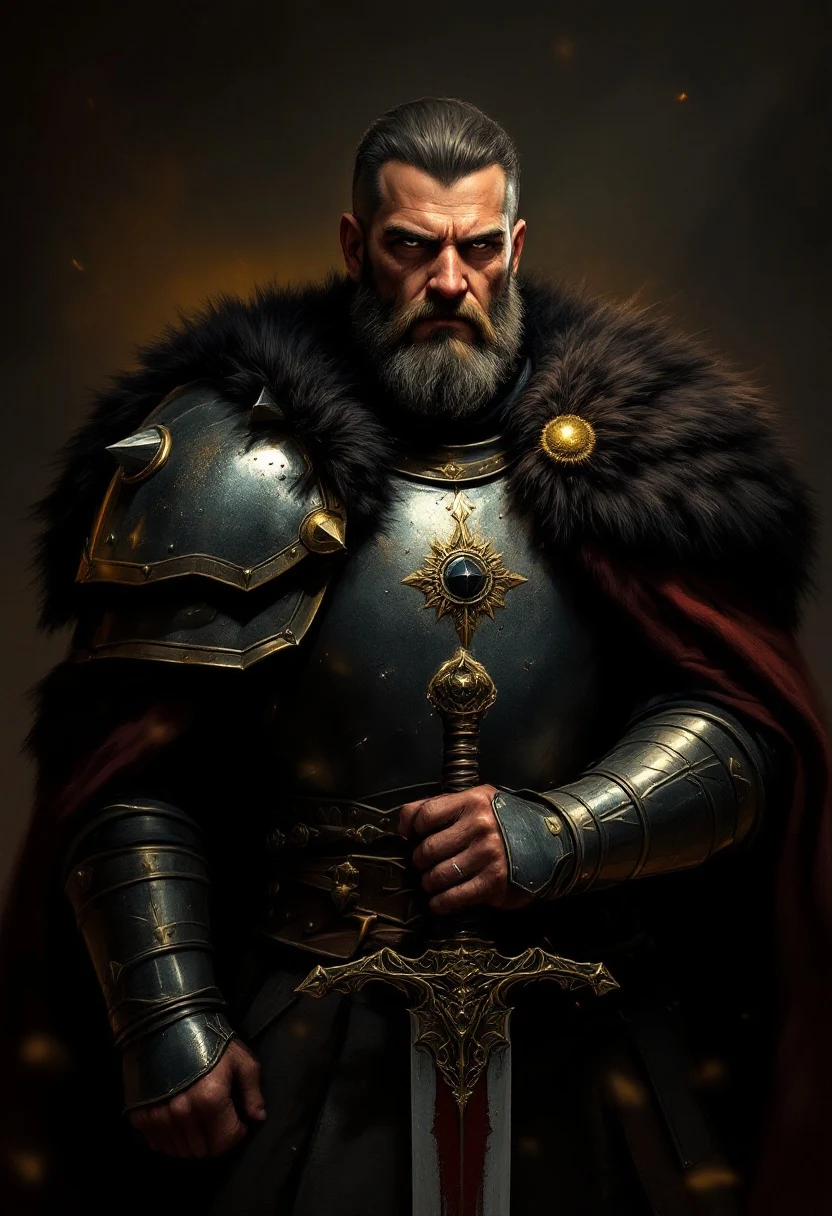
Iron Marshal Voss
Holds three border keeps by fear alone. His terms are simple: kneel, or be broken.
Use this build →
Squire Perrin
Sixteen, earnest and terrified — he swore his oath a week early to defend a village no one else would.
Use this build →Counsel
Frequently Asked
What is a paladin in D&D 5e?
A holy warrior bound by a Sacred Oath. Heavy armour, melee, and divine power channelled into smites, Lay on Hands and the Aura of Protection. Half-casters from level 2, with Charisma powering nearly everything they do.
How do I build a paladin in 5e?
Strength or Dexterity for attacks, then Charisma — it drives smites, auras and your spell save DC. Take a defensive Fighting Style, carry a shield, and choose your oath at level 3. Save slots to Divine Smite on the big hits.
What is the best paladin subclass?
There is no single best. Vengeance and Conquest hit hardest; Ancients and Redemption endure longest; Devotion is the flexible all-rounder. For a villain, take Oathbreaker.
What stats are best for a paladin?
Strength first (or Dexterity for a finesse build) for attacks, then Charisma — it powers smites, Aura of Protection and your spell save DC — then Constitution for durability. Wisdom, Intelligence and the unused physical stat come last.
Can a paladin be evil? What is an Oathbreaker?
Yes. A paladin who breaks their oath — or embraces the dark — can become an Oathbreaker: commands undead, radiates dread, and makes an excellent recurring antagonist or redemption arc.
What spells should a paladin take?
Bless and Shield of Faith at 1st; Aid, Find Steed and Lesser Restoration at 2nd; Aura of Vitality and Crusader’s Mantle at 3rd. You prepare from the full list daily, so lean on buffs and let Divine Smite carry burst.
Paladin vs Cleric — which should I play?
Paladin if you want the front line, huge burst and party-wide auras. Cleric if you want more slots, range and full casting. Paladins are simpler and hit harder; clerics are more versatile.
Swear the Oath
Read the rules, choose your oath, and forge the paladin — all on one page. Your first is free.
Forge a Paladin NPC